I have always had a passion for gardening, and even as a young boy I had a small patch of my own in my Dad’s garden in West London, growing lupins, flag irises and snapdragons.
I moved to Dedham in late 1977 and over the last forty years have lived in about eight or more different properties around the village. I have been greatly surprised by the differing planting conditions from one area of Dedham to another, each providing their own challenges.
My first modest garden was on heavy clay and quite poorly drained; being on former farm land it had never been cultivated. I remember it took me several weeks to completely dig it over, and cost me a couple of forks and spades which I managed to break due to the heavy site. But the clay soil was ideal for roses, and good for plants requiring moist conditions such as the yellow-flowered Lysimachia punctata.
After four years I moved about a half a mile up the road to a property with sixteenth-century origins which obviously had been previously cultivated. Here the garden was a complete contrast with a very sandy soil, which was great for growing lavender and sun-loving rock roses (helianthemums) but was a real nightmare in summer to keep watered. One of the highlights in the garden was a Judas tree (Cercis siliquastrum) which enjoyed the well-drained conditions and produced a most wonderful display of pea-like, bright pink flowers on the bare branches in early spring, followed by lovely heart-shaped leaves in summer. A more modern cultivar today is Cercis canadensis ‘Forest Pansy’ which I am growing in a large pot; along with the usual pink flowers, it produces reddish purple leaves and is especially useful for adding leaf colour other than green.
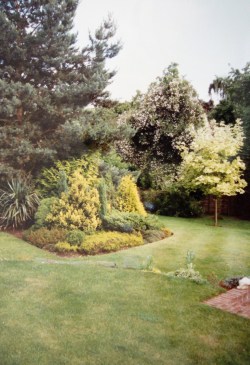 Moving on to the north of Dedham on a high ridge, with wonderful views over Dedham Vale, the garden there had quite heavy soil being moist for much of the year. It had a well which (even in the driest of summers) was always within 12 inches from the top. I often thought it would have been a good idea to use it to water the garden, but I never did.
I planted numerous trees there. Notably a Liquidambar styraciflua (sweet gum tree) with wonderful five-lobed leaves (similar to a maple leaf) which also turn to a rich reddish-purple colour in autumn, and a Cedrus deodara, with delightful pendulous branches and grey-green pine needles. However, both have grown to be quite large trees so are not suitable for a small garden. I found a variety of hardy osteospermum, which much to my surprise, seemed to enjoy the moist heavier soil, and became a most useful ground-cover plant, always giving a good display of flowers throughout the summer. I always take a root of this to my next garden!
After yet another move, I arrived at a garden that had been designed by Notcutts and planted up in the 1950s; the soil was lovely and moist, humus rich, easy to dig and keep weeded. This was a lovely mature garden with two wonderful large holm oaks (Quercus ilex). It grew wonderfully tall blue delphiniums and there were splendid beech hedges which served to create compartments in the garden, but were a lot of work to keep trimmed each year. As well as a large formal pond with lots of goldfish, there was a lovely natural pond fed by a stream at the bottom of the garden.
 I have now gone full circle and almost back to ‘square one’, in that I now live with a brand-new garden, which in 2015 was an unused farm yard, and has wonderful views towards East Bergholt. This garden is very gravelly and stony and did tend to dry out in the hot summer we have just had. So far I have only grown a lot of annuals, particularly annual cosmos, which gave a great display all summer and are still flowering even now in mid-November (at the time of writing). The warm summer suited the gold, white and mauve dahlias I planted, along with purple Salvia Amistad. Needless to say, over the winter months I shall be eagerly designing my new garden, ready to start planting in early spring 2019 – it will be a very exciting time for me.
I hope the gardens I have left behind are being enjoyed by their new owners; I even get the chance to see them developing with age as I go about the village.
Perhaps the moral of this tale is to grow plants that enjoy the conditions that you have in your own particular garden (following Beth Chatto’s mantra) and also NOT to move house so often!
~ Colin Clifford
 Dedham Horticultural Society