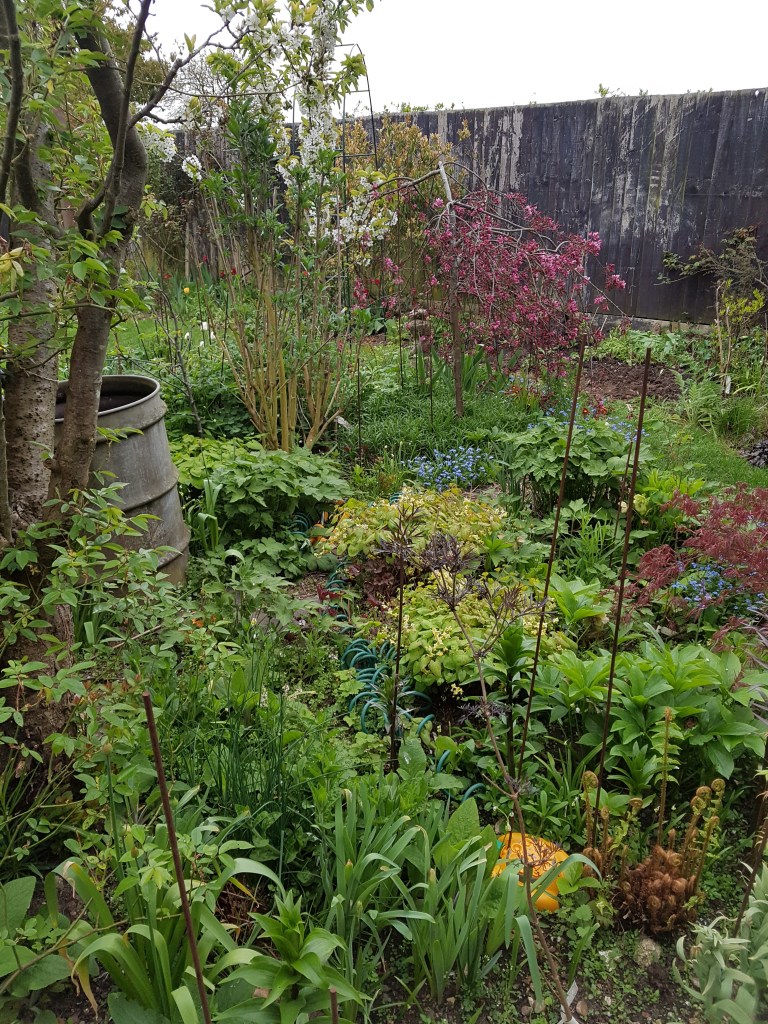
The garden’s in full on growth mode now. Everywhere I look something is shooting up or spreading out, which of course means weeds need pulling up or hoeing off (if the weather stays dry), stems need supporting and something always – always – needs pruning.
As I’m trucking secateurs, hand fork, trowel, Japanese razor hoe (best thing ever, you should get one), tubs and white bags of cut material back and forth across the garden, there’s still time to enjoy the fat buds of rhododendrons and peonies waiting to burst later in spring, as well as blossom, wall flowers, primroses and Erysimum ‘Bowles’s Mauve’ in bloom. I’ll pull some tender, bright pink stalks of forced rhubarb for the kitchen too and enjoy the huge amount of colour seen in the greens, purples and reds of stems and foliage.
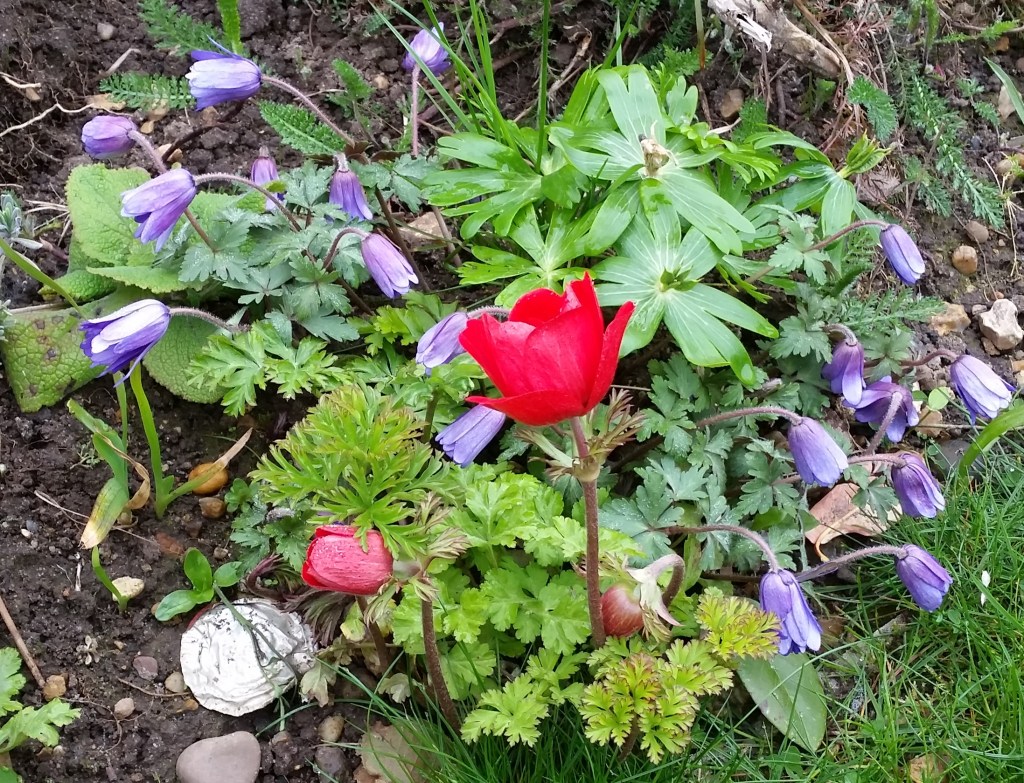
Many of the bulbs are still going strong and, alongside the usual, two anemones are looking especially good: the soft blue Anemone blanda alongside the stronger jewel tones of Anemone cornaria. The petals of the red coronaria contrast with the blue of the blanda, but there’s also a touch of blue around its boss of stamens that complements perfectly.
I’ll also check to see which – if any – of my overwintered pelargoniums (often called geraniums, although they’re nothing alike and shouldn’t be treated alike) have made it through. I’ve only just started growing these in pots and I’m not sure I’ve quite got their needs right to get them through the worse of the weather. But I learn something new in every gardening year, so will persevere.
I planted tomato seeds on the window ledge in early March and they should be ready to pot on into larger containers with split canes for support. It’s still too early to plant them out but when I do, I always have spares that go to the Horticultural Society’s plant sale in May.
The blossom looks great as always, but I’m mindful of the late and heavy frost last May which meant my fruit crops were much less than hoped for. I doubt I’ll be able to protect every tree (and certainly not the large old greengage) but will get some fleece draped over my St Edmunds Pippin apple treet, which I bought because my dad lives in Bury.
I’ll also check on the hardwood rose cuttings that I’ve had in pots for a couple of years now. A quick look underneath to see if roots are starting to show through the pots’ drainage holes will indicate whether they need potting on. I usually put a few of these into our plant sale too, so you might find some if you’re able to pop along to Dedham’s churchyard on the day.
Then there’s lawncare. I don’t love a lawn, though it certainly sets off the rest of the garden (I’m told) and I’ve boosted mine with a clover mix that encourages pollinators. This year or next, I’m going to reduce my grassy areas to just a small circle and pave the rest in the hope I can maintain the smaller area to a better level of ‘perfection’ (hah).
First job in April is to scarify the grass, which essentially means scraping away with a spring-tine rake to get as much moss (or thatch) out and let air to the roots of the grass. It’s hard work, but I bought a cheap electric scarifier which is easier and quicker, and it’s amazing just how much comes out. Very compacted areas that get walked on a lot will benefit from spiking with a garden fork: just drive the tines in, wiggle them gently back and forth and move six inches or so to the next spot and repeat. I’ll dig out any perennial weeds (dandelion is my lawn’s bête noire), feed it with a high-nitrogen fertiliser and, if it’s dry enough, give it a mow with the blades high.
When not outside, I need to read (again) about how to grow peaches. I cannot seem to get more than the odd fruit (and competing with wasps for that one) and suspect I’m cutting back the wrong branches when I prune later in the year. (No stone fruit should be pruned in winter).
Most peach trees suffer from leaf curl and, while there aren’t any chemical sprays to control it, you can try an organic winter tree wash. You can also try shrouding the tree with a polythene lean-to (I know, what next?!) to protect it from rain which spreads the spores. You’ll need to leave it open on the sides or remove it on dry days so pollinators can get to the blossom. However you’re spending these (hopefully) warmer, longer days in the garden, I hope you find something here to motivate or inspire.
 Dedham Horticultural Society