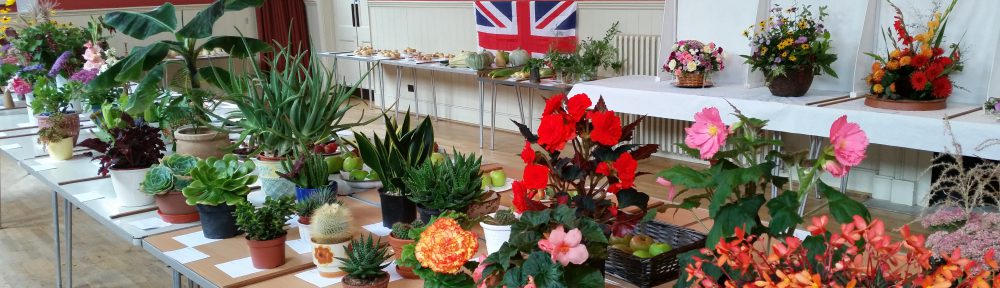
Thank you to everyone who exhibited at or came along to our annual Spring Show. More than two dozen people entered classes for plants and flower arranging, cookery and photography this year. Walking into the Assembly Rooms, visitors were hit with a riot of colour and the scent of spring.
Spring is our daffodil show with 15 separate classes to exhibit the best of your blooms. It’s a great section to enter as nearly everyone has a daffodil or two in the garden or a planter. However, the classification of daffodils can be confusing, so – if you are thinking about planting a few bulbs this autumn – here’s more of an explanation.
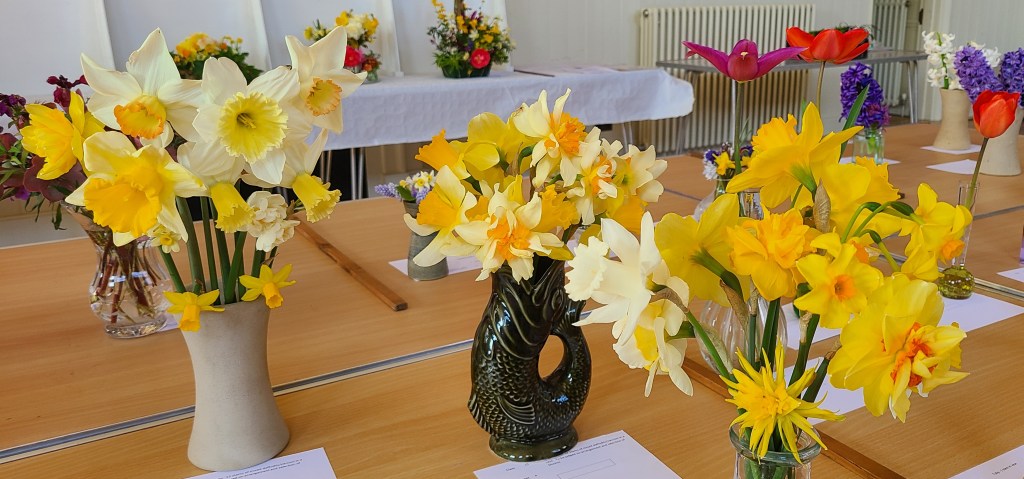
Daffodil is the common name for the botanical classification of Narcissus (plural Narcissi). This bulbous perennial (it comes back and will slowly spread over the years) is typically shades of yellow but also white/cream and orange/peach. But what are we talking about when we say trumpet, corona and perianth?
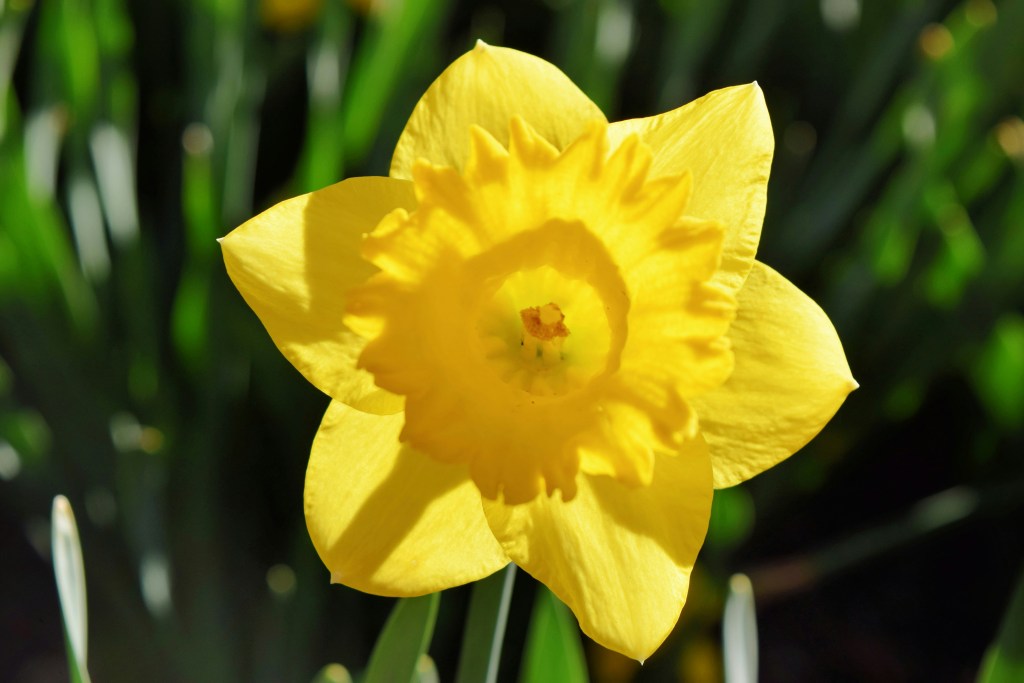
The stem and leaves sprout from the bulb planted in autumn and flower from February to May depending on variety and climate. The flower itself has two key parts: the corona in the centre, which is surrounded by the perianth.
If you think of the daffodil lying on the ground, sometimes it suggests a teacup resting on its saucer, and this gives a clue to one of the alternate names for the corona, the cup. Sometimes the corona is longer, so it’s called a trumpet (imagine the cone-like shape of the musical instrument). Still thinking of the flower lying on the ground, the perianth is the ‘saucer’ of six petals (they’re actually tepals, but you don’t need to care about that!).
Now that you know all that (you’ll thank me later), it will help you work out what to exhibit in which class.
Our classes are guided by the Royal Horticultural Society’s classification of daffodils into thirteen descriptive divisions. Classes 1-6 are for trumpet daffodils, identified by gently folding one of the petals forward. If they are the same length or shorter than the corona, then you have a trumpet.
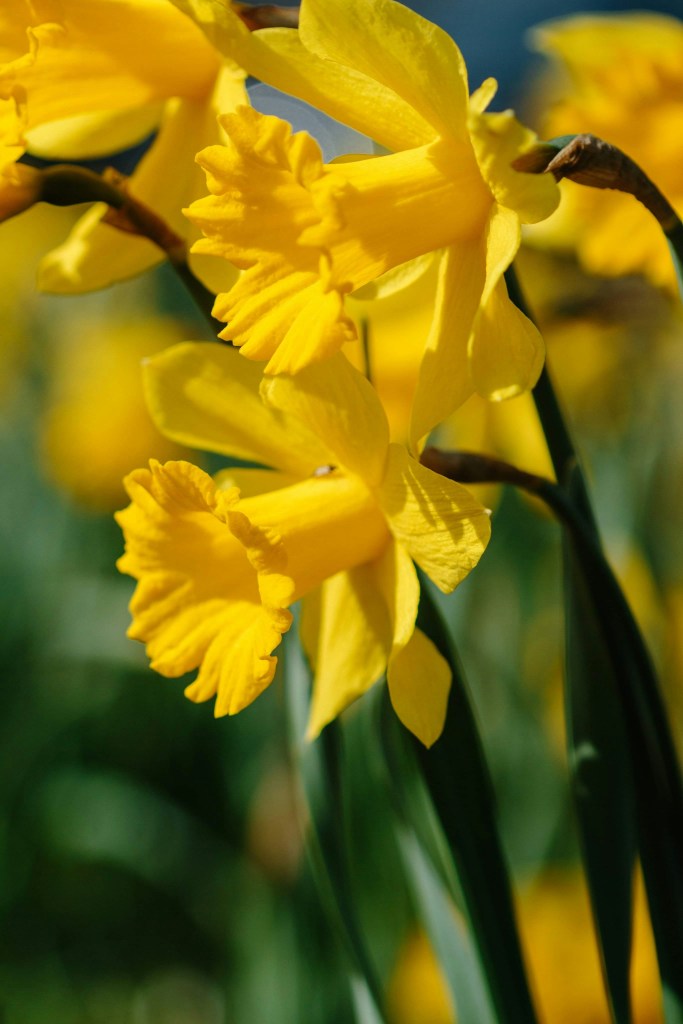
Identify your large-cupped daffodils by folding the petals forward again. If they are longer than the corona (cup), then you have a cupped daffodil – some of the cups are small and will reach less than a third of the length of the petal, others are much wider/longer and dominate the flower. The latter are the ones to exhibit here.
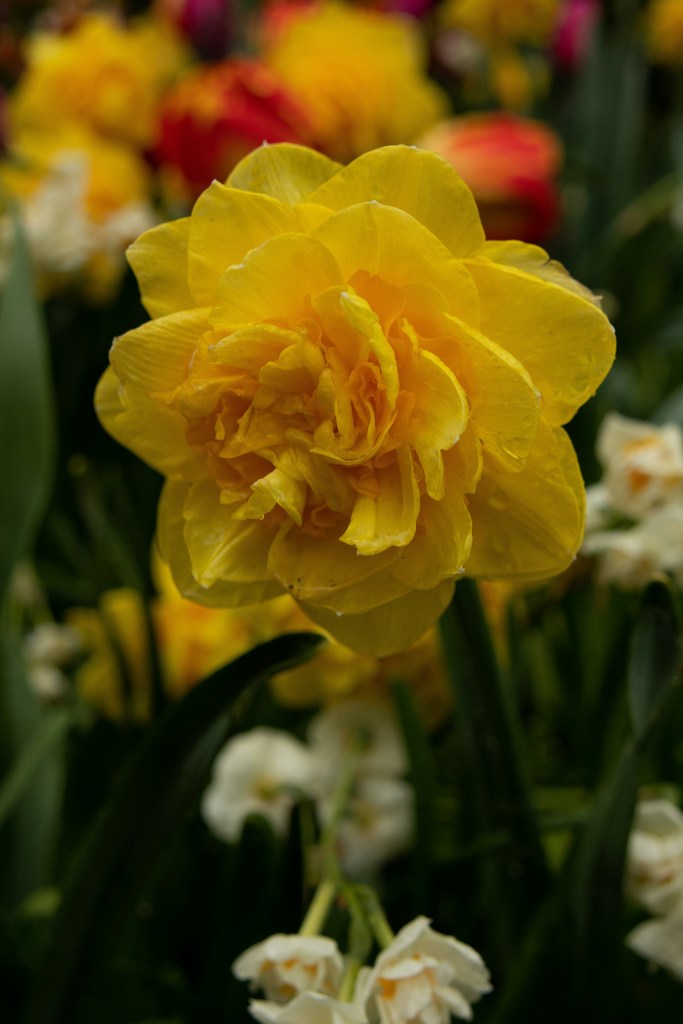
Double daffodils can be confusing. The flower itself should be doubled with a mass of petals. A daffodil with two or more flowers on the stem is NOT classified as a double daffodil unless each of those flowers has that mass of petals.
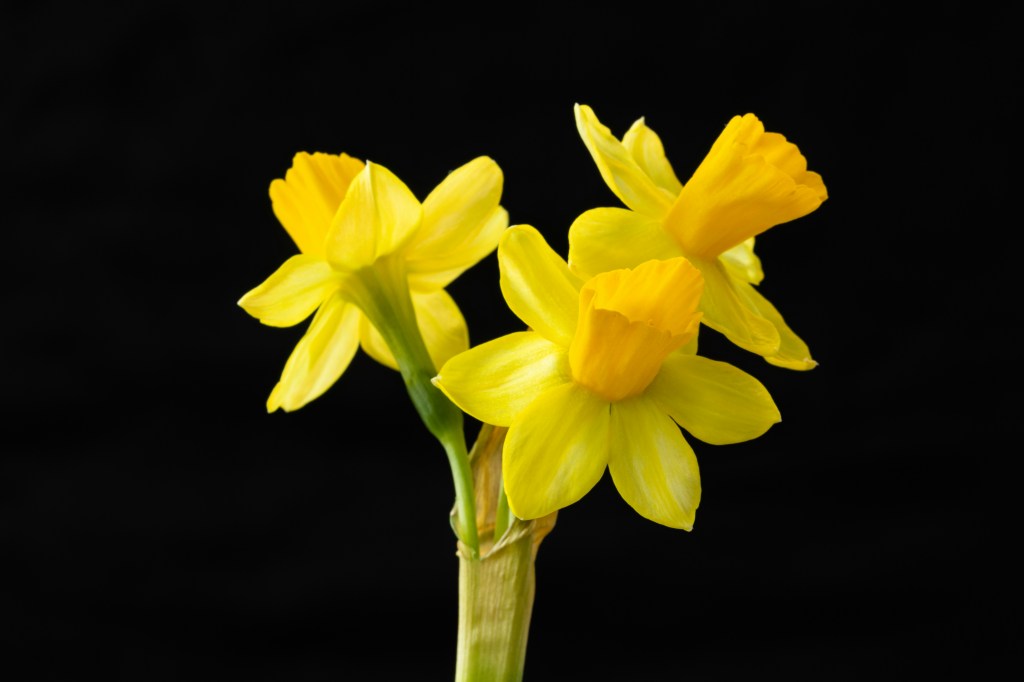
Two or more flowers on a stem is classified as triandrus and you can enter these in classes 13 and 14). These two classes are essentially for ‘any other’ type of daffodil. These include miniatures (flowers usually less than 50mm in diameter), weird-looking (I think) bulbocodium, and the pretty split-cupped. Then there’s the pheasant’s eye (classes 11 and 12) – also called poeticus – which has pure white petals and an almost flat corona with a red rim.
If you can’t be bothered remembering all that (though if you’re not sure, just enter everything on your entry form and we can help you out on the day), just find 12 daffs, make them look nice in a vase and enter class 15!
So now you know a bit more about how to exhibit daffodils in our next spring show and have a year to prepare! We hope you’ll also have a go in our Autumn Show, when it’s all about the dahlia. There’s no fee to enter as many classes as you like in either show.
 Dedham Horticultural Society