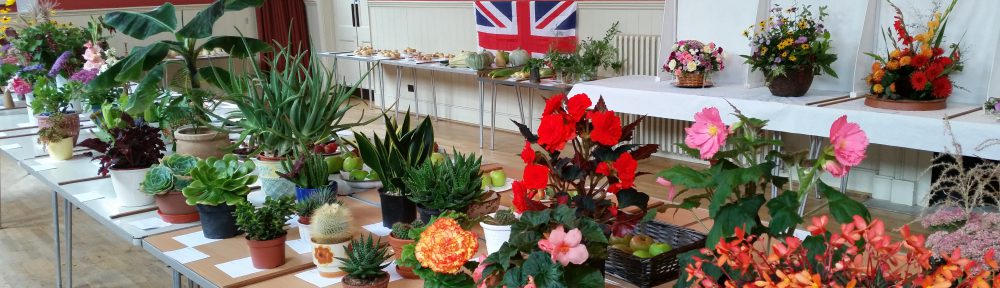
The information below comes courtesy of Brenda Eyers, who has judged the floral art section of our shows for many years. Brenda exhibits and competes at shows herself and has also shared her tips at several speaker evenings. We hope her insight proves inspiring.
Show Schedule
Always read and read again! Make sure you have a good idea of the space allowed (width, depth and height).
Aim for your design to fill approximately 75-80% of the space allowed. You will be disqualified or marked down if you exceed the space. I find it useful to cut out a sheet of newspaper or cardboard in the actual size allowed. This is especially useful for petite or miniature arrangements.
Make a drawing of your design – think about the container (which should be in scale with the plants) and any accessories you will use.
Think about how you will transport your finished design to the exhibition hall. You may be able to do it at the venue but if not think about the possibility of not putting in some of the taller or heavier material until you get to the show. It’s heartbreaking if something falls over in the car and a tall stem snaps.
Conditioning flowers and foliage
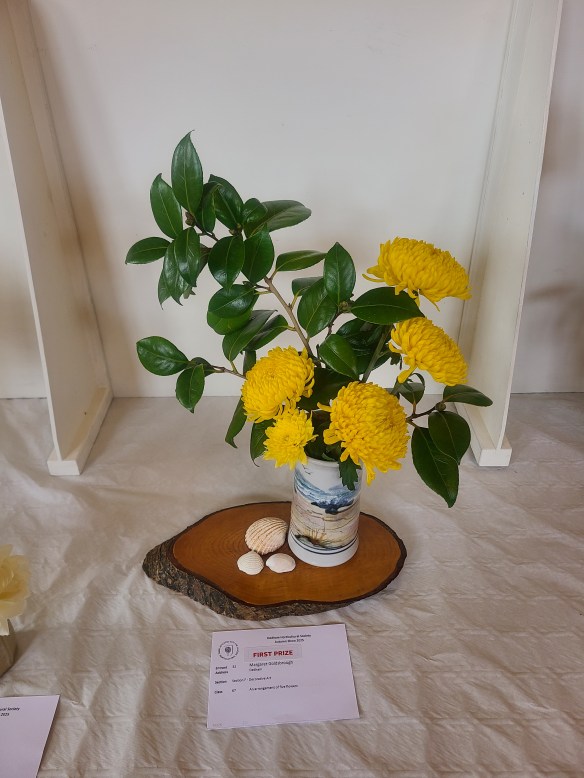
Aim to pick foliage 48 hours before you are using it. Woody stems need the ends putting in boiling water for about 10-20 seconds to release air bubbles and then plunging into a bucket of cold water. Do not put ‘velvety’ foliage in deep water.
Avoid putting the bucket in direct sunlight and store in as cool a place as possible.
Apply the same process to commercial flowers – hard stems such as roses benefit from hot water treatment. For garden plant material, it is essential so that it doesn’t droop on the show bench.
To make very closed flowers open, you can try putting them near a fan oven (or a fan) with no heat and this helps. Some flowers will open with gentle manipulation. (Note that a dahlia in bud, once cut will never open to full flower.)
Petite (between 10cm and 25cm) and miniature (less than 10cm) arrangements
I love these classes but time after time I do see common faults, so please note:
The idea is that these are scaled down version of a traditional, full-size design. The most common fault is using plant material is too big and becomes dominant.
For a petite, I suggest no bloom should be bigger than a 10p piece and for the miniatures a 5p piece.
Similarly choose foliage that is also as small as possible. You can shred up phormium into very narrow strips to use it in both designs.
Succulents work well in both petite and miniature arrangement, but they are often difficult to push into foam. My solution is ordinary dressmakers’ pins which you can push in through the bloom or underneath it and into the foam. A small piece of wire also works.
Before inserting the plant material, break the foam by making a little hollow with a cocktail or kebab stick. This make insertion much easier.
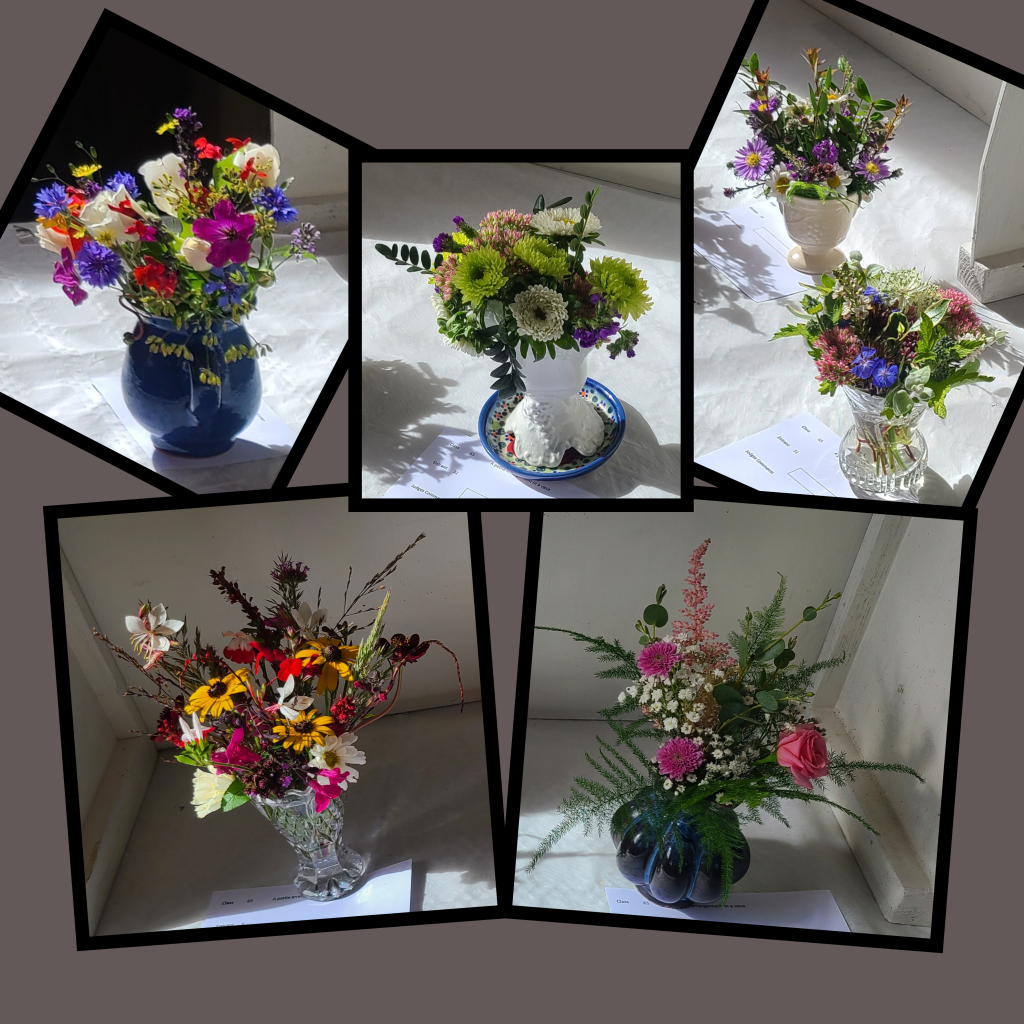
Containers for this small delicate design are also sometimes an issue. There are lots of useful things around the house such as:
- Tops of scent/shampoo bottles or cleaning products
- Small plastic boxes and cardboard if you line them with clingfilm
- Tiny clay pots
- Miniature items found in charity shops
- Small metal containers in various metals
- Pieces of slare and stone
- Seashells
I caution you to be careful of choosing a container that has a busy decoration on it as these often detract from the design of the flowers.
When you have finished your design, look at it. Then shut your eyes and count slowly to ten. When you open your eyes, what is the first thing you see? It should be your plant material not the the container. A container should complement the design.
Bases
These can make a design but also spoil it. A bse needs to enhance and compliment but not draw your attention to its presence.
A good example here is the favourite class featuring a cup and saucer. If you feel it needs a base, please choose one carefully and purposefully. A lot of exhibits I have seen over the years in this class are on a lace or cotton placemat. They rarely do anything for the design and often spoil it.
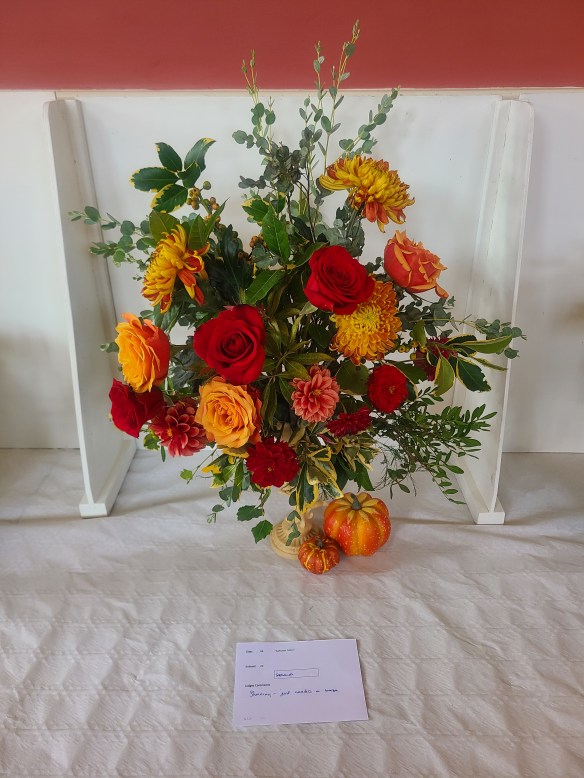
Accessories – in all designs
The important thing here is – less is more! Close your eyes as above and ask yourself are they working? Are they overpowering and distracting?
When a judge looks at a design, they are looking at the overall exhibit but the most important thing to remember is that plant material must dominate.
Judge’s comments cards
I would like to finish by saying that our aim as judges is never to discourage or embarrass the competitor. The aim is to try to help you understand why your design di or di not win and make helpful suggestions that will hopefully inspire you for the next show.
And – as I was taught when I trained with the Essex Guild of Judges many years ago – “remember it’s a show – you are showing what you can do and what you have achieved in growing, cooking, flower arranging and so on”. Not everyone can win every time and some of us will never win a cup or a first prize, but it is the showing that is important.
 Dedham Horticultural Society