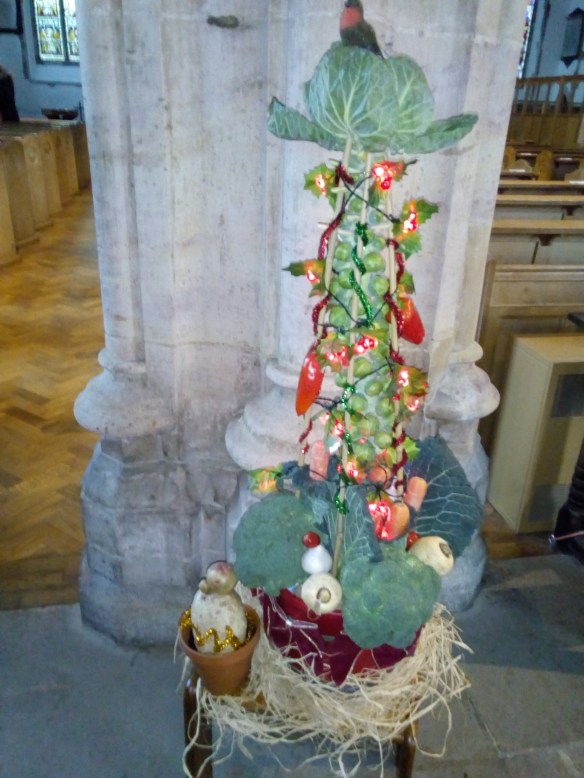
The ‘veggie’ Christmas tree

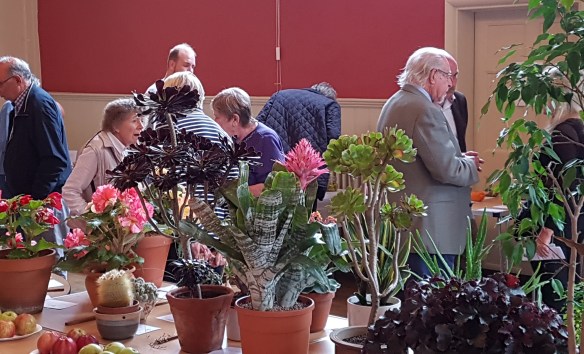
Once again the Dedham Horticultural Society has entered the village’s annual Christmas tree festival. This year we celebrated the vegetable side of horticulture with our ‘veggie’ tree.

Calabrese, root vegetables, peppers and sprouts all formed the structure of the ‘tree’ with a cabbage as tree topper.

As ever there was a huge amount of competition, so we await the results with baited breath.

Veggie Christmas tree 2018

My gardening journey around Dedham

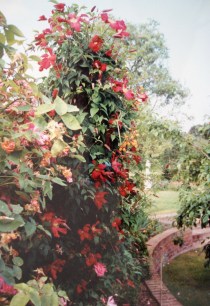
Clematis

I have always had a passion for gardening, and even as a young boy I had a small patch of my own in my Dad’s garden in West London, growing lupins, flag irises and snapdragons.

I moved to Dedham in late 1977 and over the last forty years have lived in about eight or more different properties around the village. I have been greatly surprised by the differing planting conditions from one area of Dedham to another, each providing their own challenges.

My first modest garden was on heavy clay and quite poorly drained; being on former farm land it had never been cultivated. I remember it took me several weeks to completely dig it over, and cost me a couple of forks and spades which I managed to break due to the heavy site. But the clay soil was ideal for roses, and good for plants requiring moist conditions such as the yellow-flowered Lysimachia punctata.

After four years I moved about a half a mile up the road to a property with sixteenth-century origins which obviously had been previously cultivated. Here the garden was a complete contrast with a very sandy soil, which was great for growing lavender and sun-loving rock roses (helianthemums) but was a real nightmare in summer to keep watered. One of the highlights in the garden was a Judas tree (Cercis siliquastrum) which enjoyed the well-drained conditions and produced a most wonderful display of pea-like, bright pink flowers on the bare branches in early spring, followed by lovely heart-shaped leaves in summer. A more modern cultivar today is Cercis canadensis ‘Forest Pansy’ which I am growing in a large pot; along with the usual pink flowers, it produces reddish purple leaves and is especially useful for adding leaf colour other than green.

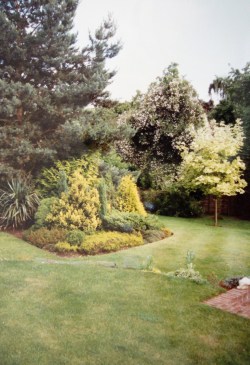
An early gardenMoving on to the north of Dedham on a high ridge, with wonderful views over Dedham Vale, the garden there had quite heavy soil being moist for much of the year. It had a well which (even in the driest of summers) was always within 12 inches from the top. I often thought it would have been a good idea to use it to water the garden, but I never did.

I planted numerous trees there. Notably a Liquidambar styraciflua (sweet gum tree) with wonderful five-lobed leaves (similar to a maple leaf) which also turn to a rich reddish-purple colour in autumn, and a Cedrus deodara, with delightful pendulous branches and grey-green pine needles. However, both have grown to be quite large trees so are not suitable for a small garden. I found a variety of hardy osteospermum, which much to my surprise, seemed to enjoy the moist heavier soil, and became a most useful ground-cover plant, always giving a good display of flowers throughout the summer. I always take a root of this to my next garden!

After yet another move, I arrived at a garden that had been designed by Notcutts and planted up in the 1950s; the soil was lovely and moist, humus rich, easy to dig and keep weeded. This was a lovely mature garden with two wonderful large holm oaks (Quercus ilex). It grew wonderfully tall blue delphiniums and there were splendid beech hedges which served to create compartments in the garden, but were a lot of work to keep trimmed each year. As well as a large formal pond with lots of goldfish, there was a lovely natural pond fed by a stream at the bottom of the garden.

Colin CliffordI have now gone full circle and almost back to ‘square one’, in that I now live with a brand-new garden, which in 2015 was an unused farm yard, and has wonderful views towards East Bergholt. This garden is very gravelly and stony and did tend to dry out in the hot summer we have just had. So far I have only grown a lot of annuals, particularly annual cosmos, which gave a great display all summer and are still flowering even now in mid-November (at the time of writing). The warm summer suited the gold, white and mauve dahlias I planted, along with purple Salvia Amistad. Needless to say, over the winter months I shall be eagerly designing my new garden, ready to start planting in early spring 2019 – it will be a very exciting time for me.

I hope the gardens I have left behind are being enjoyed by their new owners; I even get the chance to see them developing with age as I go about the village.

Perhaps the moral of this tale is to grow plants that enjoy the conditions that you have in your own particular garden (following Beth Chatto’s mantra) and also NOT to move house so often!

~ Colin Clifford

The show goes on…

Despite a very hot and dry summer that didn’t do much for dahlias, we once again hosted a very successful autumn show at the Dedham Assembly Rooms.

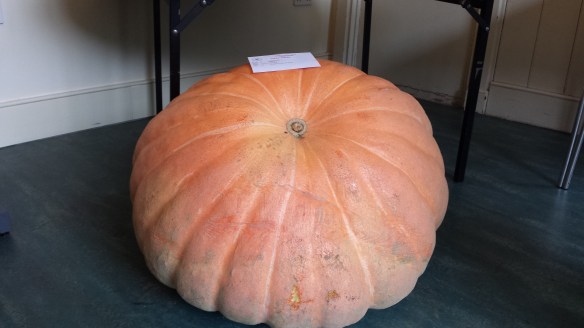
Nearly 50 people put forward 392 exhibits to be judged – up on last year – including 11 children in our junor classes. Our biggest pumpkin winner, Reg Appleby, barrowed a massive beast from the local allotment into the Assembly Rooms; a herculean task that I think is making him rethink whether to try for a bigger one next year.

Biggest pumpkin 2018

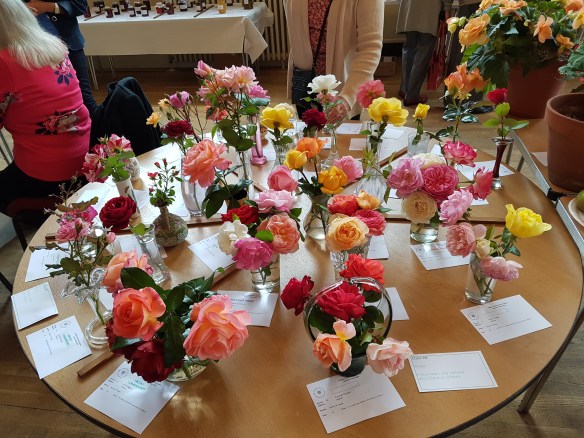
There were plenty of photography entries this year, which meant that four people shared the winning trophy, while the weather had been kinder to our rose bushes with a spectacular display of scent and colour.

Autumn2018_roses

Several people had spent a lot of time in the kitchen, turning out chelsea buns, sticky swiss rolls and a wide variety of sausage rolls. Some lovely jams and preserves were on display too. For the first time, visitors could buy some of the jams and cooking on display with a new produce stall in the tearoom.

All in all, it was another great day for Dedham and everyone is now looking forward to the Spring Show in 2019.

Autumn2018_exhibits01

How dahlias are classified

The autumn show is only four months away (trust us, it’ll go quick) and as ever there will be a number of dahlia classes to enter. If you’re not used to growing or showing dahlias, there wide range of forms can be confusing. So if you don’t know your cactus from your collarette or pompon from ball, here’s a brief guide (courtesy of the National Dahlia Society) and examples of each one (click on each picture to enlarge them).

Decorative, cactus, pompon and single-flowered are usually the types that feature in our autumn show and we have provided a little more information on ball and pompon dahlias as they can be more difficult to tell apart.

Formal decorative

Decorative dahlias have fully double blooms showing no disc.  The ray florets are generally broad and flat and may be involute (curled or curved inward) for no more than 75% of their length (longitudinal axis) or slightly twisted, and usually bluntly pointed.


Cactus

Cactus dahlias have fully double blooms, the ray florets are usually pointed, the majority narrow and revolute for 65% or more of their length (longitudinal axis) and either straight or incurving.


Pompon

Pompon dahlias have fully double spherical blooms of miniature size (no bigger than 55mm in diameter except on the case of large poms which should not exceed 75mm) with florets largely involute along their length (longitudinal axis).

According to the RHS Horticultural Show Handbook, blooms are perfectly globular. Florets involute for the whole of their length, evenly and symmetrically arranged throughout the bloom and dessing back fully to the stem. Bloom facing upwards on a straight, firm stem.

Single-flowered

Single dahlias have blooms with a single outer ring of florets, which may overlap, the centre forming a disc.


Anemone-flowered

Anemone-flowered dahlias have blooms with one or more outer rings of generally flattened ray florets surrounding a dense group of tubular florets, and showing no disc.


Collarette

Collerette dahlias have blooms with a single outer ring of generally flat ray florets, which must overlap, with a ring of small florets (The Collar) the centre forming a disc.


Waterlily

Waterlily dahlias have fully double blooms characterised by broad ray florets that are slightly involute along their length (longitudinal axis) giving a saucer shaped appearance to the bloom. The depth should be not more than one third of the diameter of the bloom.


Ball

Ball dahlias have fully double blooms, ball shaped or slightly flattened.  The ray florets are rounded at the tips, with margins spirally arranged and involute for at least 75% of the length of the florets. For exhibition purposes miniature flowered varieties must not exceed 115mm and small flowered varieties must not exceed 170mm.

According to the RHS Handbook, blooms should be ball-shaped but the tendency towards flatness on the face of the largest cultivars is acceptable. Ray-florets compact and dense at the centre, symmetrically arranged, dressing back to the stem to complete the ball shape of the bloom. Florets compact and dense at the centre. Bloom poised at an angle of not less than 45 degrees to the stem, which should be straight and of a length and thickness proportionate to the size of the bloom.

Semi-cactus

Semi-Cactus dahlias have fully double blooms; the ray florets are usually pointed and revolute for more than 25% and less than 65% of their length and broad at the base and either straight or incurving.


Miscellaneous

Any dahlias which do not fall into type 1 – 9 inclusive and type 11, 12,13 & 14 e.g. Thistle Dahlias, etc. This group includes species dahlias.


Fimbriated

Fimbriated dahlias have blooms where the tips of the ray florets should be evenly split or notched into two or more divisions, uniformly throughout the bloom to create a fringed overall effect.  The petals may be flat, involute, revolute, straight, incurving or twisted.


Star

Star dahlias have blooms with a single outer ring of florets surrounding the disc.  Ray florets are uniformly either involute or revolute.


Double orchid

Double Orchid dahlias have fully double blooms showing no disc and have triangular centres.  Ray florets are narrowly lance shaped and either involute or revolute.


Paeony

Paeony dahlias have multiple outer rings of ray florets surrounding a disc, ray florets are flat or slightly involute at base and are flat or are to some extent revolute.
Enter a photo class

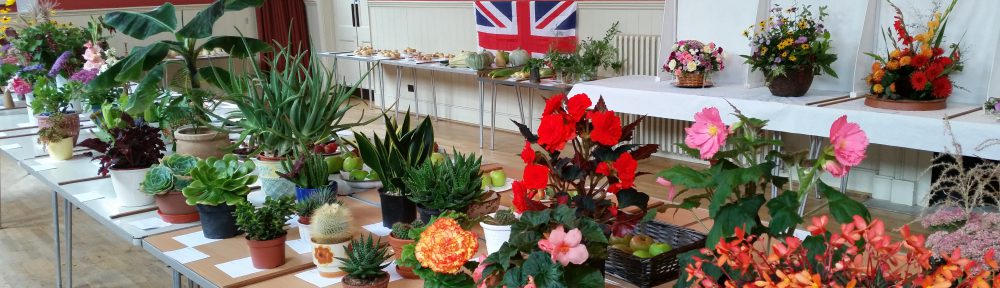
Photography judging at the Dedham Horticultural Society shows.

The photography classes are an important part of our spring and autumn shows, but have you ever wondered how they get judged? To help you create stronger entries, we asked judge Roy Laverick for his insight. He told us that he assesses each entry under three headings and awards points depending on how well they measure up.

Relevance (maximum 2 points)

“This generally results in an automatic two points for every entry, since it is unusual (but not unknown) to be confronted with a photo that does not comply with the class title for which it has been entered. I try to interpret this title as broadly as possible, but occasionally I just cannot see how the subject matter complies with class title, and the photo is accordingly barred from proceeding further through the judging process.”

Composition (maximum 5 points)

“In this area, I am particularly looking for photos that have a clear centre of attention to which the viewer’s eye is drawn. This will usually be towards the centre of the picture but need not necessarily be so. The way in which the subject matter has been framed within the viewfinder when the photo was taken, and subsequently during cropping (if carried out) is vitally important. Cropping can make or break a good photo and is something that should be considered very carefully.

“At every show I see otherwise superb photos, which are spoilt because they have been over-cropped. For instance, it is generally undesirable for a photo of a pot or bowl of flowers to feature blooms and/or stalks which pass out of the picture. Conversely, it is unfortunate if the prime subject of the photo is so small that it cannot be readily appreciated.”

Technical (maximum 5 points)

“Under this heading I am trying to ensure that the shot does not suffer from significant technical shortcomings, such as being out of focus in key areas or badly exposed (giving excessive lightness or darkness). I try to make allowance for photos that have obviously been printed at home, but if this process has resulted in noticeable ‘barring’ or ‘blurring’ (implying that the domestic printer is not up to the task being asked of it) the photo has little chance of being awarded a high mark.”

Choosing the winners

“The above marking process will sort the wheat from the chaff, but it is likely that a number of likely ‘winners’ will all have been awarded the same mark and this is now that a ‘tie break’ is applied. This takes the form of identifying which of the prints with a particular score has the greatest ‘wow factor’ and accordingly deserves for award purposes to be placed above its similarly marked competitor(s).

“‘Wow factor’ is very much a personal judgement and defies scientific definition. I am looking, however, for a photo that grabs the attention of the viewer as a result of being commendable for composition or technical ability and which also features spectacular colour and/or lighting. Sometimes there are like-marked photos, both of which have a high ‘wow factor’: that’s when the judge’s task becomes really difficult.”

So bear Roy’s tips in mind if you’re thinking of entering your photos in our next show.

Question Time: Betty Cox

We catch up with Betty Cox, Treasurer of the Dedham Horticultural Society.

Tell us about your garden
When my husband, Bob, and I moved to Dedham 30 years ago, the garden was mainly laid to lawn with a small veg patch.

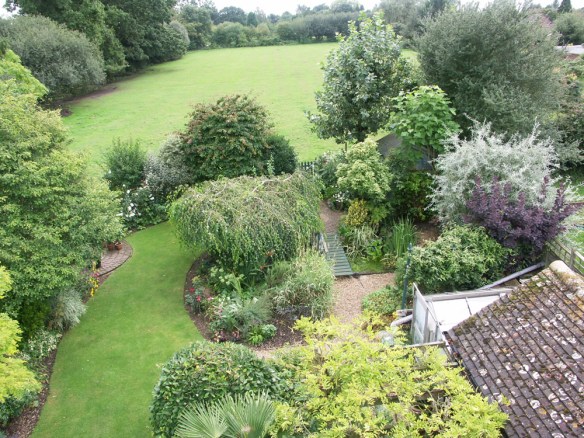
After a few years, we decided to employ a garden designer to revamp both the front and back gardens.  We chose a theme of circles for the hard landscaping, linked together by lawn and paths.  Borders were extended for planting and a section behind the garage housed a greenhouse and a formal pond.  Some small trees were planted together with shrubs to give structure and height to the planting.

A Mount Fuji cherry is the main tree in the front garden, which gives fragrant white flowers in early Spring and in the Autumn the leaves turn to glowing hues of yellow and orange. In the back garden there is a Perrotia Persica, a Weeping Birch and a Weeping Pear, all of which are now well established. An Amelachier, which was an original tree, is one of my favourites.

the_willows

The back garden is south facing and houses a patio with numerous pots. These are planted with many annuals to give colour in both the winter and spring. I love cottage garden plants so there are numerous roses, geraniums, salvias and so on.

Favourite plant?
There are many, but I am especially fond of agapanthus, pale blue, dark blue and white.  These are mainly grown in pots and when their flowers appear I know it is summer.

What’s been your biggest garden mistake?
Probably planting the wrong plant in the wrong place in the garden. Some shady loving plants planted in full sun.

Getting into the greenhouse

betty_cox

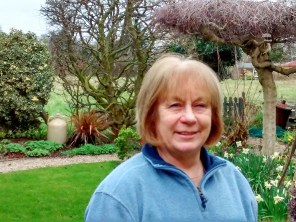
Betty in her garden

I have a small greenhouse with a heated propagator and I love to get in and plant up seeds and take cuttings.  I always grow tomatoes and cucumbers from seed and have a passion for growing sunflowers from the 6ft Russian Giants to the small border ones.

Summing Up
I can think of nothing more therapeutic than being out in the garden: it is good for mind, body and soul.

Thatching and harvesting the straw

On 4 April, Malcolm Macbeth talks to the Society about thatching in a traditional way that his family has been following for almost nine decades. He will share how to thatch a roof using long straw and water reeds.

Although the majority of thatching straw today comes from modern varieties, Malcolm reaps, thrashes and stacks thousands of sheaves of traditional and local wheat grown specially for them every year.

Once a common sight in fields across England, producing traditional thatching straw today is a niche occupation. It requires a gentle touch – and harks back to an age when farms enlisted help from dozens of local people at harvest time. Malcolm continues to use the type of agricultural machinery – and traditional methods – familiar in their grandfather’s day.
A team of eight – often local teachers and students – bring in the harvest, helped by a 70-year-old Albion 5A reaper binder. It cuts the wheat, transporting it by a canvas conveyor belt to be tied before leaving the sheaves on the field to be stooked. Then a fleet of four tractors delivers the crop to the yard, where it is thrashed in a 1949 Ransomes thrashing machine and stacked.

Join us at the Assembly Rooms in Dedham on 4 April at 730pm to learn more about this fascinating heritage industry. DHS members are free with guests just £2.

RHS Hyde Hall Summer Flower Show

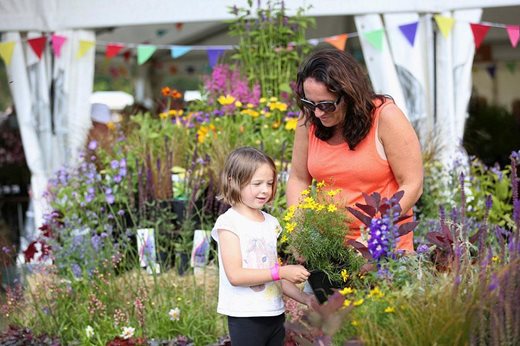
We are planning a coach trip to RHS Hyde Hall, near Chelmsford, on Saturday 4 August when they have their annual Summer Flower Show.

We will leave Royal Square, Dedham at 9.30am and depart from Hyde Hall at 4pm, giving ample time to explore the different gardens, visit the exhibitors’ stands and marquees and to enjoy refreshments.

The cost per ticket will be in the region of £9 – £12 per person, depending on how many wish to come. The cost is for the coach fare only as we are affiliated to the RHS and therefore benefit from free admission to Hyde Hall. Members are welcome to bring guests but their tickets will cost slightly more.

Please let us know as soon as possible if you would like a ticket(s) for this outing and no later than Tuesday 15 May.

mother-and-daughter-buying-plants_940x627

Question Time: Elliott Frisby

elliott_show

Tell us about your garden in 100 words or less:
“South-facing, about 100 ft and longer than it is wide. A large hedge separates the garden from a mini orchard that I’ve put in. I’ve got some mature shrubs including a lovely Nandina domestica (heavenly bamboo) and a couple of unidentifiable trees. I’m playing with different borders – cottage, jewel and woodland – and trying to tie them together. I have brilliant dahlias and grasses for great late-summer displays. Lots of roses, peonies and lilies also have their place and I have a bit of a problem with ever-spreading Achillea ptarmica. I’m hoping some large Salvia guarantica black and blue’ will survive to complement my Thalictrums too.”

joanbealess

Favourite plant in your garden?
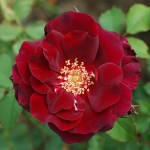
“It’s a shrub rose, ‘Joan Beales’: an open double with a great scent and a lovely deep velvety red.”

What’s been your biggest garden mistake?
“Being too keen to plant bulbs then slicing into them when adding plants above.”

What is your favourite garden or show to visit and why?
“I like looking around Beth Chatto’s: it’s local with interesting ideas that should work for my own garden. They have a great, reasonably priced nursery too. I prefer the Hampton Court Flower Show to Chelsea – the displays are just as good but there’s more room to look around. I really want to get to Sissinghurst to see what all the fuss is about.”

Whose advice would you follow most?
“Definitely Monty Don and the BBC’s Gardeners’ World. I’m very jealous of Longmeadow, although there’s no way I could keep up with it on my own. Because of Longmeadow’s size, each week there seems to be something on the programme that I can do in my own garden.”

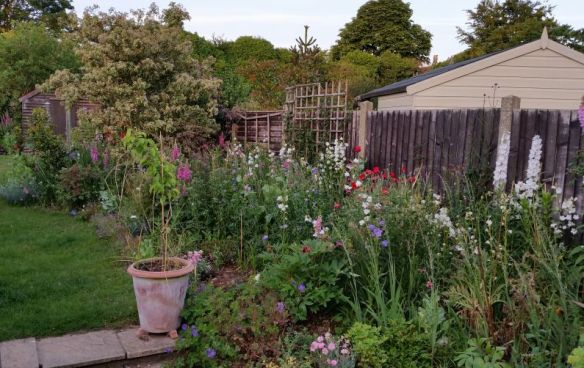
elliott_cottageborderinjune

My cottage border in June

If you could grow only one, which would you choose: flowers, fruit or veg?
Flowers. I like the challenge of fruit and vegetables but I’m afraid I don’t do enough cooking to make full use of them. I like growing flowers from seed and use some of my allotment to grow them on until they’re ready to go into the garden.